The Racehorse in Art
Former Trustee of the National Horse Racing Museum and owner of the Cox Library, Tim Cox, explains the popularity of racehorses in art
22/04/2026 Paintings, Drawings & Prints
On 26th April 1721 the Duke of Devonshire’s Childers beat the Duke of Bolton’s Speedwell in a match over four miles for 500 guineas (£105,000 in today’s money) on Newmarket Heath. In a short career Childers built such a reputation for speed that he has been known as Flying Childers ever since. And his reputation was further enhanced by the many portraits painted of him, particularly by John Wootton and James Seymour. One of those pictures by Wootton (Fig 1) has been donated recently to the National Horseracing Museum under the Government’s Acceptance in Lieu Scheme. It will be on display with two others (Bloody Shouldered Arabian and Ashridge Ball) at the Museum.
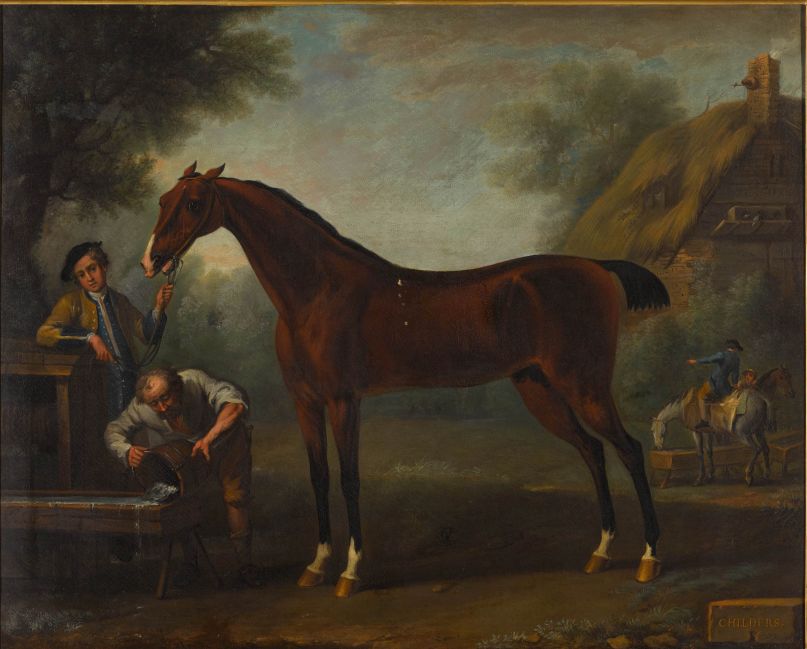
Duke of Devonshire’s Flying Childers by John Wootton (c.1725), oil on canvas, 99.1cm x 124.5cm credit: National Horseracing Museum
For 305 years since that race owners have memorialised their champions (and not so great horses) and their races in paint, prints, bronze, and photographs. It’s fair to say that Wootton probably got the colour and markings of the horse right, but there must be doubts that he really painted the horse that he saw. His horses often appear as though they were painted from a template. However, his portraits do provide an important record of the best horses before the days of published records.
It was the great George Stubbs that took up the challenge of painting the horse that he really saw. For eighteen months he locked himself away in a barn in Horkstow. Lincolnshire. Between 1756 and 1758 he studied and drew the anatomy of a horse. He carefully removed layers of skin and muscle, recording every minute detail as he went. The result was the publication of The Anatomy of the Horse in 1766.
A selection of preparatory drawings for The Anatomy of the Horse is on display at the National Gallery until 10th May 2026. They are the opening works in a small exhibition that is focussed Lord Rockingham’s Scrub.
This is a life-size painting of a horse that raced between 1755 and 1761. He was painted at the same time as Stubbs’s other life-size portrait, Whistlejacket. A close study of Scrub shows the influence of Stubbs’s dissecting work. There is the hint of ribs suggesting that Scrub had just come out of training.
The one challenge that even Stubbs could not manage was the portrayal of movement. He had a go with his portrait of Baronet in 1891.
This is the first picture that shows a horse at the gallop with all four feet off the ground. Before Baronet artists used the convention of the rocking horse gallop (two back feet planted and the front legs leaping forward). The Stubbs Flying Gallop became the convention until 1872 when Muybridge was able to show the true nature of the gallop though a series of photographs. Slowly artists recognised the importance of Muybridge’s work and the lessons that it taught us about the movement of the horse.
For over three hundred years artists have taken up the challenge of providing owners with a permanent memory of their favourite horses and their achievements. The challenges have been twofold. First to get the horse to look like the horse you see, and second to get the movement right. Perhaps the third challenge is to get the patron to like what he sees. And to pay for the commission.
To view the wonderful collection of racing paintings at the National Horseracing Museum, please visit the museum's website here
Cheffins auctions often feature racing art, view the calendar of sales here